



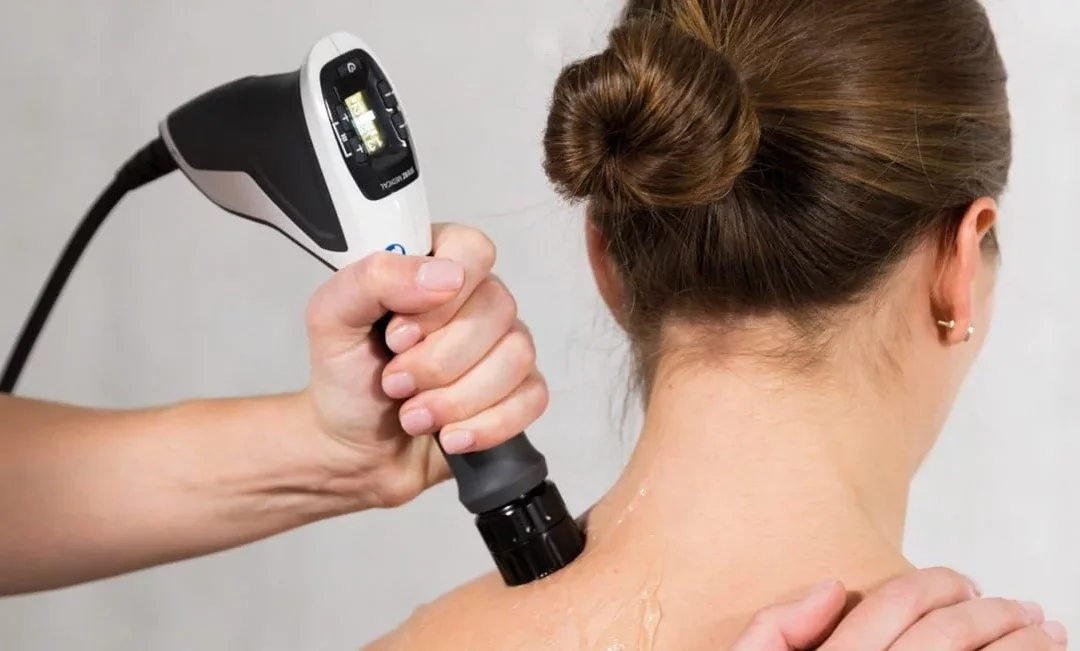
What Is Shockwave Therapy?
Shockwave therapy (also called Extracorporeal Shockwave Therapy, or ESWT) is a non-invasive treatment that uses sound wave energy to stimulate healing in injured or chronically painful tissues.
A handheld device is placed against your skin over the affected area. It sends rapid pulses of acoustic energy (the “shockwaves”) into the tissue beneath. You feel a tapping or thumping sensation. The treatment usually takes between 5 and 15 minutes per session, depending on the area being treated.
Despite the name, shockwave therapy does not involve electrical shocks. The word “shock” refers to the pressure wave, not electricity.
How Does It Work?
When tissue in your body is injured, your body normally sends blood flow and healing cells to repair the damage. But sometimes, especially with chronic conditions, that healing process gets “stuck.” The tissue becomes less responsive and the pain lingers for months, sometimes longer.
Shockwave therapy works by essentially waking up that stuck healing response. The acoustic energy:
- Increases blood circulation to the area
- Breaks down calcific deposits (calcium build-up in tendons)
- Stimulates collagen production, which is important for tendon and tissue repair
- Disrupts pain signals in the local nerve fibres, which can reduce discomfort
The goal is to restart the body’s own healing process, rather than masking the pain or bypassing it entirely.
What Conditions Is Shockwave Therapy Used For?
Shockwave therapy is commonly used for chronic musculoskeletal conditions, particularly those involving tendons and connective tissue. At Pro Motion Clinic, our Kelowna chiropractors may consider shockwave therapy as part of a treatment plan for:
Plantar Fasciitis
This is one of the most studied applications of shockwave therapy. Plantar fasciitis causes pain in the heel and bottom of the foot, often the worst first thing in the morning. It is very common among runners, hikers, and people who spend a lot of time on their feet. For Kelowna residents who are active on the trails around Okanagan Mountain Park or Knox Mountain, this one shows up often.
Achilles Tendinopathy
Chronic irritation of the Achilles tendon, the large tendon at the back of your ankle, is another condition where shockwave therapy is frequently used. It is particularly relevant for cyclists and runners.
Rotator Cuff Tendinopathy
Pain and stiffness in the shoulder related to the tendons of the rotator cuff can sometimes respond well to shockwave therapy, particularly when there is calcification present.
Patellar Tendinopathy
Also called “jumper’s knee,” this condition affects the tendon just below the kneecap. It is common in volleyball players, basketball players, and other athletes who jump frequently.
Tennis Elbow and Golfer’s Elbow
Lateral and medial epicondylitis, the formal names for these conditions, involve chronic tendon pain around the elbow. Shockwave therapy is often explored when other approaches have not provided enough relief.
Hip Pain (Greater Trochanteric Pain Syndrome)
Pain on the outside of the hip related to the tendons around the greater trochanter is another area where shockwave therapy has been studied.
What Does a Shockwave Therapy Session Feel Like?
Most people find shockwave therapy tolerable, though it is not entirely painless. You will feel the pressure pulses on your skin, and the sensations can range from mild tapping to a deeper thumping feeling. If the treatment is targeting a very tender spot, you may feel some discomfort during the session.
After a session, it is common to experience some temporary soreness in the treated area for 24 to 48 hours. This is a normal response as the tissue begins to react to the treatment.
Shockwave therapy is almost always delivered as a series of sessions, not a one-time treatment. Typically, a course involves three to five sessions spaced about one week apart. Your chiropractor will assess your response as you go and adjust accordingly.
Is Shockwave Therapy Safe?
Shockwave therapy has a well-established safety profile and is approved by Health Canada for clinical use. Serious side effects are uncommon.
That said, it is not appropriate for everyone. Your chiropractor will review your health history and the specifics of your condition before recommending it. Shockwave therapy is generally not used:
- Directly over growth plates in children and adolescents
- Over areas of infection or open wounds
- In patients on blood-thinning medications, depending on dose
- During pregnancy
- Over areas with active malignancy
This is exactly why a thorough assessment comes first. At Pro Motion Clinic, every patient goes through a detailed intake and evaluation before any treatment is recommended.
Shockwave Therapy vs. Other Chiropractic Treatments
Shockwave therapy is one tool in a larger toolkit. It is often used alongside other treatments, not instead of them.
For example, a chiropractor in Kelowna might combine shockwave therapy with:
- Active Release Therapy, to address muscle and soft tissue restrictions
- Therapeutic Ultrasound, which also uses sound energy but at a different frequency and depth than shockwave
- Rehabilitation exercises, to build the strength and movement patterns that support long-term recovery
- Myofascial Release Therapy, to address broader tension patterns contributing to the injury
The combination your chiropractor recommends will depend on your specific condition, how long you’ve had it, and how your body has responded to previous treatments.
How Do I Know If Shockwave Therapy Is Right for Me?
Here are a few questions worth thinking about before your appointment:
How long have you had the pain?
Shockwave therapy tends to be most relevant for chronic conditions, meaning pain that has been present for three months or longer. Acute injuries are typically managed differently in the early stages.
Have you tried other treatments?
Shockwave therapy is often considered when initial approaches like rest, ice, manual therapy, or stretching have not fully resolved the problem. It is not necessarily a first-line treatment for every condition.
Is the diagnosis confirmed?
A proper assessment matters. Conditions like plantar fasciitis or Achilles tendinopathy need to be properly assessed and confirmed before any treatment plan, including shockwave therapy, is put in place. Pain in the heel does not automatically mean plantar fasciitis, for example.
Are you willing to commit to a full course?
Shockwave therapy works over a series of sessions. Stopping after one or two visits may not give you a fair indication of how your body responds to the treatment.
The most reliable way to find out if shockwave therapy is appropriate for your situation is to book a comprehensive initial assessment with a chiropractor who can evaluate you properly.
Shockwave Therapy at Pro Motion Clinic in Kelowna
At Pro Motion Clinic, our chiropractic team offers shockwave therapy as part of a comprehensive, one-on-one treatment approach. Every appointment is private. You work directly with your practitioner for the full session, and your treatment plan is built around your specific goals and history.
We serve patients from across the Central Okanagan, including downtown Kelowna, Glenmore, Rutland, Mission, West Kelowna, and Lake Country.
If shockwave therapy is something you want to explore, or if you’re just not sure what approach is right for your pain, we’d encourage you to start with an assessment. Our team can walk you through what we’re seeing, explain your options, and help you make an informed decision.
Ready to Find Out If Shockwave Therapy Could Help You?
Book an initial chiropractic assessment at Pro Motion Clinic in Kelowna. Our team will take the time to understand your condition, answer your questions, and put together a treatment plan that makes sense for you.
Call us at (236) 420-0660 or book online at promotionclinic.janeapp.com.