TPI Assessments Kelowna
Improve golf performance with TPI assessments in Kelowna. Book expert screening at Pro Motion Clinic – (236) 420-0660.
Your back tightens up on the 14th hole. Your shoulder clicks during the backswing. You lose power after nine holes even though you hit balls at the range three times a week. Sound familiar?
Here’s what most golfers don’t realize: your golf swing doesn’t cause these problems. Your body does.
When your hips won’t rotate properly or your thoracic spine is stiff, your body finds workarounds. These compensations let you complete your swing, but they create stress on joints that weren’t meant to handle it. That’s where Titleist Performance Institute (TPI) assessments come in.
What Titleist Performance Institute (TPI) Assessments Actually Measure
The Titleist Performance Institute developed a system that shows how your body moves—and where it doesn’t move the way it should. At Pro Motion Clinic in Kelowna, our TPI-trained Chiropractors use this assessment to connect the dots between your physical limitations and what’s happening in your golf game.
Think about someone who can’t rotate their torso properly. They’ll still try to make a full backswing. But instead of rotating from the thoracic spine like they should, they might sway laterally or arch their lower back excessively. This compensation pattern shows up as a reverse spine angle in their swing—a common cause of lower back pain in golfers.
The assessment looks at 16 different movements. Some test how well your joints move. Others check if your muscles fire in the right sequence. A few evaluate balance and stability. Each one reveals something about how your body might be limiting your swing or setting you up for injury.
How the Assessment Works
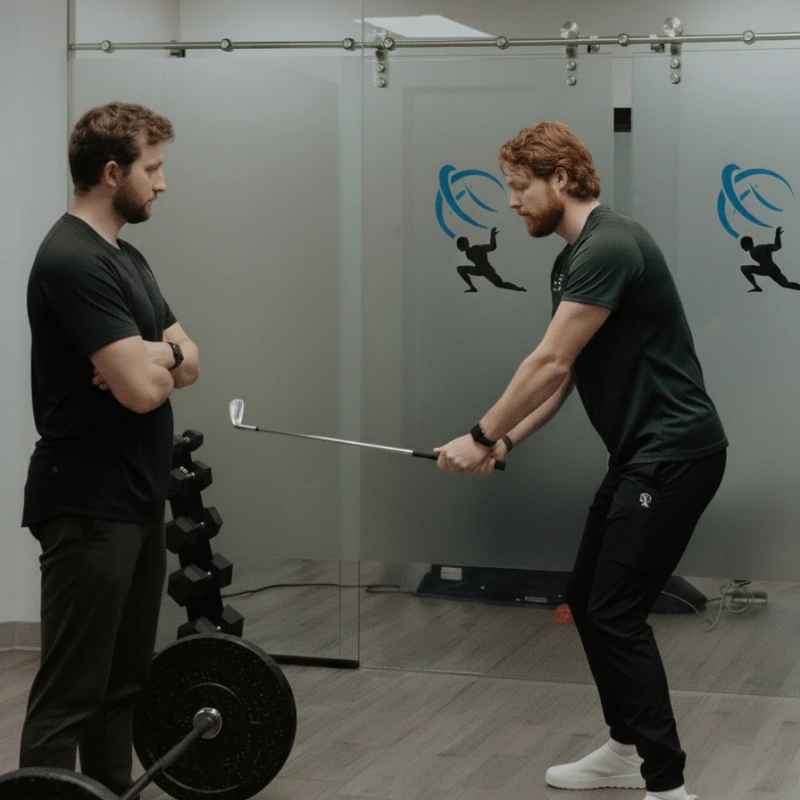
You’ll move through a series of positions that mimic parts of the golf swing. Can you rotate your upper body while keeping your hips stable? Does one shoulder move differently than the other? When you bend forward, where does the movement come from—your hips or your lower back?
Our Chiropractors watch how you perform each movement. They’re not just looking at whether you can complete it. They’re observing compensation patterns. Maybe your knee collapses inward during a single-leg balance test. That suggests weak hip stabilizers—the same muscles that need to work during your weight transfer in the swing.
The assessment takes about 45 minutes. You’ll wear comfortable clothes that let you move freely. No golf clubs needed for this part, though seeing your actual swing helps complete the picture.
Each test gets scored. The results map directly to specific swing characteristics that TPI has identified through years of studying professional and amateur golfers. A tight hip flexor, for instance, correlates with early extension—when your hips move toward the ball during the downswing instead of rotating.
What Happens After Your TPI Assessment
This is where Pro Motion Clinic’s approach differs from just getting a fitness test. We don’t hand you a generic exercise sheet and send you home. We have a Medical 2 (M2) TPI Certification as well as an SFMA certification.
Our Chiropractors use the TPI results as part of a bigger plan that includes patient education, exercise rehab, manual therapy, and Shockwave Therapy in Kelowna when needed. We treat the actual restrictions the assessment found—not just the symptoms.
Let’s say your TPI assessment shows limited ankle mobility and poor hip rotation. These restrictions might be causing you to lose posture during your swing, which leads to inconsistent ball striking and occasional lower back discomfort after playing 18 holes.
First, we’d address the joint restrictions with chiropractic adjustments. Stiff joints don’t suddenly become mobile just because you stretch them. They need manual therapy to restore proper movement. Then we layer in specific exercises that retrain movement patterns and build stability in the positions your golf swing actually uses.
For golfers dealing with chronic issues, Shockwave Therapy can help break up tissue restrictions that have developed over months or years of compensating. This treatment uses acoustic waves to stimulate healing in stubborn areas that haven’t responded to other approaches.
The goal isn’t just to help you pass the movement tests. It’s to change how your body functions so your golf swing works with your body instead of against it.
Who Benefits from Titleist Performance Institute (TPI) Assessments in Kelowna
You don’t need to play on the PGA Tour to benefit from understanding your body’s limitations. TPI assessments help anyone who plays golf regularly and wants to either improve performance or reduce pain.
Weekend golfers who play the Okanagan courses deal with the same physical demands as competitive players—they just swing fewer times per week. But those weekend rounds at Gallagher’s Canyon or Shadow Ridge still require hip mobility, shoulder stability, and thoracic rotation. If your body can’t provide those movements efficiently, you’re building up stress with every swing.
Competitive amateur golfers use TPI assessments to find the physical limitations holding back their game. You might have worked with a golf coach who keeps telling you to turn more or shift your weight better. But if your body physically can’t make those movements, no amount of practice will help. The assessment shows what needs to change in your body before the swing changes will stick.
Golfers recovering from injuries benefit because the assessment reveals whether you’ve developed compensation patterns during recovery. Maybe you had a shoulder injury six months ago. It healed, but now you’re getting lower back pain when you play. The TPI assessment might show that you’re still protecting that shoulder unconsciously, which is forcing your spine to work harder than it should.
Older golfers who want to keep playing without pain use these assessments to address age-related changes in mobility and strength. Your swing doesn’t have to look like it did when you were 30. But your body does need to move efficiently for whatever swing style works for you now.
The Connection Between TPI Results and Common Golf Injuries
Lower back pain in golfers usually comes from one of a few movement problems. Limited hip rotation forces the spine to rotate more than it should. Poor core stability means the spine has to work harder to transfer power from the lower body to the upper body. Lack of thoracic spine mobility makes the lumbar spine compensate with excessive movement.
The TPI assessment identifies which of these problems you have. Then we can address the root cause instead of just treating the pain.
Shoulder issues often develop when golfers lack the thoracic rotation or shoulder flexibility needed for a full backswing. The shoulder joint compensates by moving in ways it wasn’t designed for. Over time, this can lead to rotator cuff problems or impingement.
Elbow pain—whether it’s golfer’s elbow on the inside or tennis elbow on the outside—frequently develops from poor sequencing in the kinetic chain. When your body doesn’t transfer power efficiently from the ground up through your legs, core, and torso, your arms work overtime to generate clubhead speed. That extra work stresses the tendons around the elbow.
Wrist injuries often happen when golfers have limited forearm rotation or weak grip strength. The TPI assessment includes tests that reveal these limitations before they become problems.
How TPI Fits with Your Golf Instruction
The best results happen when your body work and swing instruction work together. Your golf coach can see what’s happening in your swing. The TPI assessment shows why it’s happening.
Maybe your coach keeps working with you on maintaining your spine angle through impact. But if you have tight hip flexors and limited ankle mobility, your body will physically struggle to maintain that position. The TPI assessment gives your coach information about what changes are realistic based on how your body currently moves.
Some golfers at Pro Motion Clinic work with local Kelowna golf instructors who are familiar with the TPI system. This makes the process even more effective because everyone’s speaking the same language about the body-swing connection.
Other golfers come in without working with a coach. That’s fine too. The physical improvements from addressing TPI findings often lead to natural improvements in swing mechanics without formal instruction. When your hips can actually rotate and your thoracic spine isn’t locked up, your body finds more efficient movement patterns on its own.
What Makes Pro Motion Clinic’s Approach Different
Plenty of places can give you a TPI assessment. We take it further by integrating those results into a treatment plan that actually addresses what we found. We have a Medical 2 (M2) TPI Certification as well as an SFMA certification.
Our Chiropractors understand both the assessment and how to treat the restrictions it reveals. We’re not just trainers who know the TPI system. We’re licensed healthcare providers who can use manual therapy, exercise prescription, and advanced treatments like Shockwave Therapy to create lasting changes.
The clinic’s location at #202-3030 Pandosy Street makes it easy for Kelowna golfers to fit appointments into their schedule. Whether you play at Kelowna Golf & Country Club, work downtown and hit balls at Sunset Ranch after work, or drive from West Kelowna to play at Mission Creek, the clinic is centrally located.
We also work with active people beyond just golf. If you ski at Big White in the winter, hike Knox Mountain in the summer, and play golf in between, we understand how to keep your body functioning well for everything you do. The movement patterns that matter for golf—hip mobility, thoracic rotation, stability—also matter for other sports and activities.
What to Expect for Your First Titleist Performance Institute (TPI) Assessment
Call (236) 420-0660 or book online through the Pro Motion Clinic website. Let them know you want a Titleist Performance Institute (TPI) assessment. They’ll schedule you with one of our TPI-trained Chiropractors.
Wear comfortable athletic clothes—shorts or athletic pants and a t-shirt work well. You need to move freely through different positions. Bring your golf shoes if you want your actual golf posture assessed, but they’re not required for the movement screen itself.
Plan for about an hour for your first visit. This includes time to discuss your golf game, any pain or limitations you’ve noticed, and your goals. Then you’ll go through the 16-test movement screen. Afterward, we’ll explain what the results mean and outline a treatment plan.
Most golfers need between 6-12 treatment sessions to address the restrictions found in their assessment. Some issues respond faster, especially if they’re recent. Longer-standing restrictions that have been present for years typically need more time to change.
You’ll also get specific exercises to do between appointments. These aren’t random stretches. They’re movements that directly address what your TPI assessment revealed. Maybe it’s hip mobility work because your assessment showed limited internal rotation. Or core stability exercises because you couldn’t maintain position during certain tests.
Common Questions About Titleist Performance Institute (TPI) Assessments
Will this help my golf score?
The assessment identifies physical limitations that may be affecting your swing efficiency. Addressing these limitations can help you swing more consistently and with less effort, which often leads to better performance. However, improving your score also depends on factors like technique, course management, and mental game.
Do I need to be in shape to get assessed?
No. The assessment meets you where you are. We’re not testing how fit you are—we’re testing how well your body moves through golf-specific patterns. Someone who golfs regularly but never works out can still benefit from seeing what their body can and can’t do.
How is this different from regular physical therapy?
TPI assessments focus specifically on movements related to the golf swing. Regular physical therapy typically addresses general function or rehab from a specific injury. The TPI system connects your movement limitations to specific swing characteristics, which gives us a clear target for treatment.
Can this prevent golf injuries?
Identifying and addressing movement limitations before they cause problems may help reduce injury risk. However, no assessment or treatment can guarantee injury prevention. The goal is to help your body move more efficiently so it’s under less stress during your golf swing.
How often should I get reassessed?
Most golfers benefit from reassessment every 3-6 months, especially if they’re actively working on physical improvements. This helps track progress and identify new limitations as old ones resolve. Golfers who play year-round might reassess at the start of each season.
Taking the Next Step
Golf season in the Okanagan runs roughly April through October, though some courses open earlier and close later depending on weather. Most golfers see the best results when they address physical limitations before or early in the season rather than waiting until problems develop.
That said, there’s no wrong time to get assessed. Even if you’re already dealing with pain or performance issues mid-season, understanding what’s causing them helps you address the real problem instead of just managing symptoms.
The Chiropractors at Pro Motion Clinic understand the demands Kelowna’s golf courses place on your body. Whether you’re walking the hills at Gallagher’s or playing multiple rounds a week at different courses around the valley, we know what it takes to keep your body functioning well throughout the season.
If you’re tired of dealing with the same limitations every golf season—whether that’s pain that shows up after nine holes, a swing fault your coach can’t fix, or gradually declining distance—the Titleist Performance Institute (TPI) assessment shows you exactly what needs to change in your body.
Contact Pro Motion Clinic at (236) 420-0660 or visit the clinic at #202-3030 Pandosy Street in Kelowna. Our team can answer questions about Titleist Performance Institute assessments and help you schedule with a TPI-trained Chiropractor who understands how to turn assessment results into actual improvements in how you move and play.
Pro Motion Clinic offers Titleist Performance Institute (TPI) assessments as part of a performance-focused approach to chiropractic care in Kelowna, BC. The clinic combines movement assessment, manual therapy, exercise rehabilitation, and advanced treatments to help active individuals perform at their best.
Real results, real people
Ready to move better in Kelowna?
Book online or call our team — direct billing is available for most extended health plans.